The Server: Receive Pipeline
The server is the node that answers. Everything it does is a reaction — to a received frame, or to a timer it allowed to expire. Its responsibilities, its configuration defaults and the reasoning behind sequence validation, rate limiting and liveness are in Architecture and Design Decisions §6 and §9, and the message catalogue is in the Protocol Specification §8. This chapter adds the view neither has: the pipeline every received frame runs, and why each gate answers the way it does.
1. The pipeline

2. Why some rejections are silent and others are answered
This is the design decision that a reader of the code most often questions, so it is worth stating as a rule: a frame is answered only when it was unambiguously meant for this server and this category. If it was, silence would be a bug. If it was not, an answer would be noise.
| Gate | Answer | Reasoning |
|---|---|---|
| Standard identifier | Silent | The frame belongs to another protocol sharing the bus |
| Another node’s address | Silent | Answering would produce noise proportional to the number of servers on the bus |
| Over the rate limit | Silent | An acknowledgement is itself a frame; answering a flood would double it |
| A response, not a command | Silent | Servers do not consume responses; answering would create a loop between servers |
| Unregistered category | Silent | The frame may be legitimate traffic for another server that does implement that category |
| Empty payload, validated category | Answered | Addressed here, category exists — the client deserves to know |
| Sequence mismatch | Answered, with the expected number | The client needs that number to resynchronise without a round trip (Chapter 7) |
| Unknown message type in a known category | Answered | The client is talking to a category that does not implement that command |
Two ordering choices in the pipeline are equally deliberate:
- Liveness is marked before the rate limit is applied. A client that floods the bus is still, evidently, alive; marking liveness afterwards would make a flooding client appear to vanish.
- The rate limit is applied before the category is looked up. What is being limited is the cost of processing frames, and that cost is paid before the category is known.
One consequence of the rate limiter is worth designing around rather than discovering: it counts within a fixed window that resets on a timer, so a burst straddling a reset can deliver up to twice the configured number in quick succession. Chapter 10, §7.2 walks through it, and Chapter 11 turns it into a sizing rule.
3. Registration, and why it can fail
A category is admitted only if the server has a free slot and no other category already claims its identity — and the answer is a value the application must check, not an assertion.
That choice is deliberate: the set of categories a product registers can be configuration-dependent, and a node that finds at start-up that it cannot register everything may prefer to run degraded rather than not at all.
The cost of ignoring the answer is that an unregistered category is indistinguishable on the wire from a category that does not exist: its commands are dropped silently, by the gate above, and its client waits for responses that never come. This is entry 3.11 in Chapter 10, and it is the most common integration mistake.
The server’s own system category occupies one slot from construction, which is why an application has one fewer than the total available.
4. Sequence validation as a state machine

Four properties define the behaviour, and each is a deliberate simplification:
- The first command sets the baseline. A client that restarts from zero does not need the server to restart too — but only until the server has seen its first command.
- Rejection is idempotent. A rejected command does not advance the counter, so ten misordered commands produce ten identical answers rather than drift.
- The counter wraps naturally at the end of its range.
- One counter is shared by every validated category. Interleaving commands across two categories is therefore fine — they share one ordering — but two clients commanding one server interleave their counters and reject each other’s traffic. That is the one-client-per-server rule (REQ-CAN-006.1) showing through, and it is catalogued in Chapter 10, §4.6.
5. Liveness, in both directions

Two distinct signals are in play, and conflating them is the usual confusion:
- Any correctly addressed frame proves the client is present and restarts the timer. This matters because the client’s heartbeat is itself deferred by its own outgoing traffic: a client that commands continuously may not send a dedicated heartbeat for a long time, and must not be declared offline for being busy.
- Only a heartbeat raises the “online” notification, because that is the specific, meaningful announcement.
The offline notification is raised at most once per outage rather than once per timer expiry.
6. The heartbeat is a silence guard
The heartbeat timer is restarted after every outgoing frame, whatever produced it — which is possible only because the whole node shares one frame queue (Chapter 2). A heartbeat is therefore emitted only after a full interval of complete silence from this node.
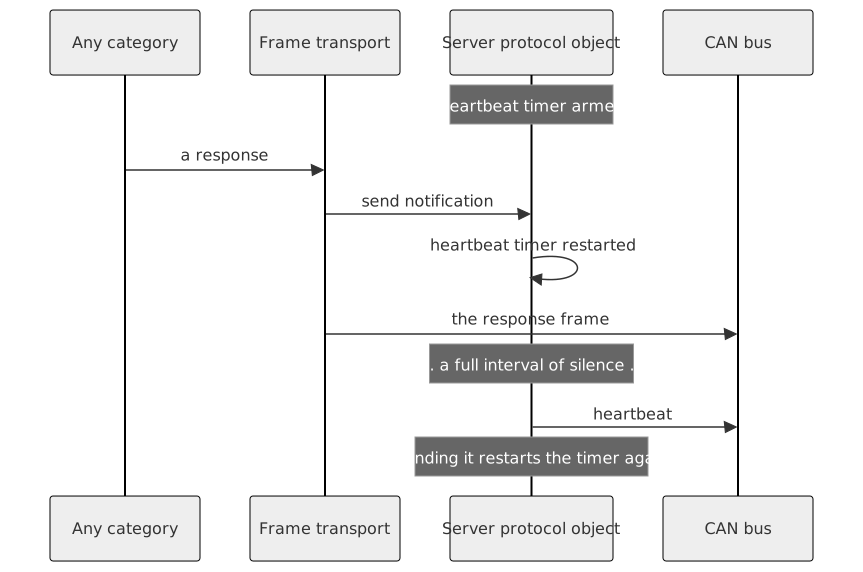
On a busy bus this reduces heartbeat traffic to nothing, because responses and telemetry already prove the node is alive. On an idle bus it produces exactly one heartbeat per interval. The same mechanism runs on the client, with the difference described in Chapter 7.
7. Attaching segmentation
Attaching the transport changes the pipeline in exactly one place — the second gate — and nothing else about the server. A reassembled payload runs the same gates in the same order, ending in the segmented dispatch path rather than the single-frame one, which is what makes segmentation invisible to a category.
The server also arranges for a transfer that fails part-way to release its channel, so a failed transfer frees its slot instead of holding it forever. Chapter 8 covers when transfers fail and what the peer observes.