The Client: Per-Server State
The client is the node that asks. It has no address of its own, it addresses servers by node identity, and it keeps a small amount of state for each server it deals with. What that state is for — sequence tracking, resynchronisation, liveness, acknowledgement timeout — is described in Architecture and Design Decisions §9.1 to §9.4. This chapter shows how it behaves: three state machines and the pipeline that feeds them.
1. Two independent tables

The two tables are separate and independently populated, and that is a design decision rather than an accident of implementation. Sequence state is created by sending; liveness state is created by receiving. A server that is commanded but never answers occupies a sequence slot and no liveness slot; a server that only emits telemetry occupies a liveness slot and no sequence slot. Merging them would mean allocating sequence state for a server that has only been heard from, or tracking liveness for one that has never spoken.
The client’s own address is never used as a source: every command is addressed to its target, and the one broadcast the client sends — its heartbeat — is broadcast because the client has no address a server could be expected to know.
2. The receive pipeline
Markedly shorter than the server’s, and every difference is deliberate.

| Difference from the server | Reason |
|---|---|
| No address filter | A client consumes frames from every server; the address on an incoming frame is the source, not a destination to match |
| No rate limiting | The client issues the traffic; limiting what it may receive would drop its own answers |
| No command/response check | A client legitimately observes broadcast heartbeats as well as responses |
| Acknowledgements are intercepted before dispatch | The interception needs the source identity, which category dispatch does not carry down |
| Nothing is ever acknowledged | Clients do not acknowledge |
The interception is the structurally interesting part. It runs on every frame, recognises acknowledgements itself, and ignores any that is malformed or claims an impossible source — cancelling no timer and changing no counter, so the command’s own timeout fires normally, which is the right outcome for a frame that cannot be trusted.
The frame still continues to category dispatch afterwards, where the system category recognises it and does nothing. That is layering rather than redundancy: the category’s registered message types stay an accurate description of what it understands, while the protocol object does the part that needs the source identity.
3. Sequence numbers: peek, then commit
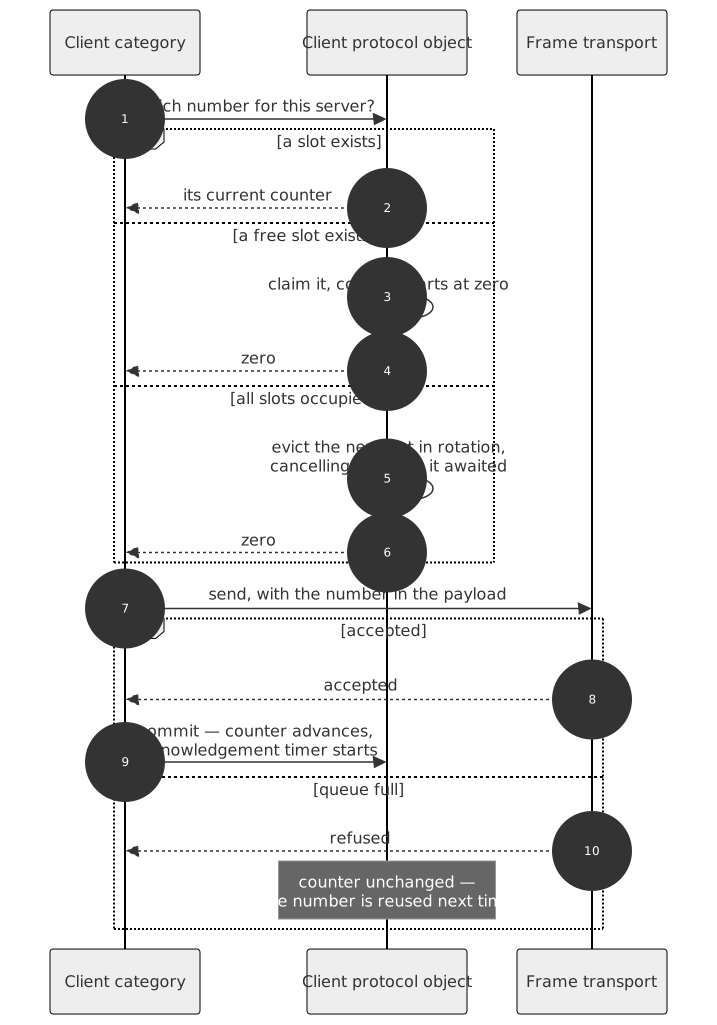
Splitting the operation in two is what makes a refused send harmless. Were the counter advanced when the number was taken, a command refused by a full queue would leave a permanent gap, and every later command would be rejected until a resynchronisation cleaned it up.
Committing for a server that was never asked for a number is a programming error, and fails loudly — reachable only by bypassing the category’s own send path.
4. Resynchronisation
A rejected command comes back with the number the server expected, which turns what would be a deadlock into a single lost command.
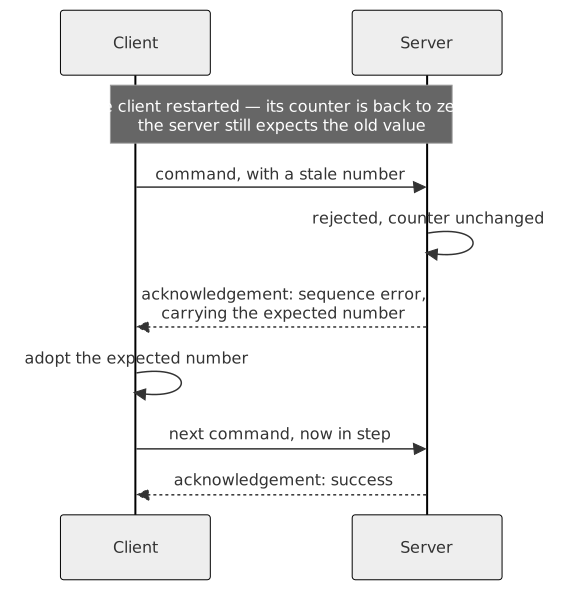
Three properties make this robust:
- The server is never asked to reset. It stays authoritative and the client adapts, which keeps the recovery one-sided and therefore race-free.
- The rejected command is not retried automatically. Replaying a command whose side effects the application may not want repeated is not a decision the protocol layer is entitled to make. The application learns of it from the missing response, or from the acknowledgement timeout.
- Nothing is reported. From the application’s point of view nothing has gone wrong that it can act on.
5. One outstanding command per server

The last transition is the one to know about. A second command to the same server replaces what is being waited for: the first command’s acknowledgement, arriving afterwards, no longer matches and does not cancel the timer, which now belongs to the second command. In ordinary request/response use this never arises, and the alternative — a queue of outstanding commands per server — costs memory a one-at-a-time protocol does not need. Its sharper edge, where two consecutive commands share an identity, is entry 5.4 in Chapter 10.
Nothing is ever retried automatically. The notification names the command that was lost so the application can retry it, escalate, or mark the server suspect.
6. Tracking servers

Any frame from a server counts as proof of life — responses, telemetry and heartbeats alike — matching the server’s rule and for the same reason: a busy peer defers its heartbeat.
Eviction is explicit rather than “ignore the newcomer”, and it reports both transitions, so the application’s picture stays consistent: at most eight servers online, every change reported. On a bus with more active servers than slots, the observer sees churn — which is the honest signal that the client is under-provisioned. The slot count is a compile-time property of the library, so raising it is a library change rather than a configuration choice.
7. Discovery, and its two limits
Asking a server what it implements is the one client operation whose answer the application must interpret, which is why it has a first-class entry point with a completion, while the rest of the system conversation is bookkeeping the client does on the application’s behalf.
Two limits follow from there being a single pending completion, and both are simplicity rather than oversight:
- One discovery at a time. A second request before the first answer overwrites the pending completion, and the first caller is never called.
- The completion does not name the responding server. An answer from a different server than the one asked will satisfy it.
Discovery also has no timeout: if the server never answers, the completion stays pending. An application that needs a deadline arms its own timer. All three are catalogued in Chapter 10, §5.