Segmentation: The ISO-TP State Machines
A classic CAN frame carries eight bytes; a firmware block or a calibration table does not fit. The transport layer solves that with ISO 15765-2 segmentation. The frame formats, the flow-control fields and the timing parameters are specified in the Protocol Specification §4.1, and the class inventory and storage pattern are in Architecture and Design Decisions §10.1. This chapter covers what neither has: the two state machines, and the failure paths through them.
The layer is optional and orthogonal. A node that attaches it gains multi-frame payloads for the message types that opt in; every other message type continues to travel as a single frame, unaware the transport exists.
1. Channels
A channel is a pair of identifiers: one carrying data in one direction, one carrying flow control back. Each channel owns one sender and one receiver, which are independent — a channel can be transmitting one payload while reassembling another, because the two use different identifiers.

Two properties of that lifecycle matter in integration:
- Channels are claimed, not pooled per transfer. A channel stays occupied after a transfer completes, ready for the next one on the same identifier pair, until it is explicitly released. This is why the protocol layer releases a channel when a transfer aborts (Chapter 6, §7) — otherwise a failed transfer would hold a slot forever.
- Identifier pairs may not overlap. Registration is refused if either identifier already belongs to another channel, because overlapping pairs would make routing ambiguous.
Routing a received frame is a decision the channel makes and reports upward: the protocol layer offers every frame to the transport and continues its own pipeline only if the transport declines. That single boolean is the whole mechanism by which segmentation is transparent.
2. The sender

The sender refuses a transfer up front rather than failing part-way: an empty payload, one beyond the protocol’s length field, one beyond the configured buffer, or a second transfer while the channel’s sender is busy are all refused at the point of asking. What is accepted is then copied into the channel’s own buffer, so the caller’s buffer may be reused immediately — which matters when the source is a stack temporary or a flash read buffer.
Pacing is the peer’s to choose. can-lite’s own receiver never asks a peer to slow down or to pause between blocks, because reassembly is a copy into a preallocated buffer and needs no pacing. Its sender nevertheless implements the general case — honouring whatever block size and separation time a peer asks for — so it interoperates with conventional stacks that do pace transfers. A pacing request it cannot parse is treated as the slowest legal value, which is the standard’s conservative reading: an unparseable request must not be read as “go as fast as you like”.
Aborts, and the completion that does not run
A transfer’s completion runs on success only. A transfer that aborts reports through the abort path instead. An application that handles only the completion will wait forever — which is why the protocol layer subscribes to the abort path and releases the channel there.
The abort reasons and what raises each are listed in the glossary. One deserves a note: a failure to hand a frame to the bus reports the same reason as an unparseable frame, because the sender genuinely cannot distinguish a full queue from a bus problem. The reason code is diagnostic; the outcome — abort, release, tell the application — is what matters.
3. The receiver

The validation it performs, in order, is where most of the interesting failure behaviour lives, and Chapter 10, §8 tabulates every case. Two asymmetries are worth understanding here rather than there:
- An oversized first frame is answered; an oversized single frame is not. A peer that sent a first frame is waiting for flow control and must be told to stop. A peer that sent a single frame has already finished and has nothing to stop.
- An unsolicited continuation frame is ignored, not treated as an error. Silence is the correct response to a frame that belongs to a transfer this receiver is not part of.
A single frame arriving mid-reassembly discards the partial transfer and is delivered as a complete payload — the pragmatic reading, since the peer has evidently moved on.
4. A multi-frame transfer, end to end
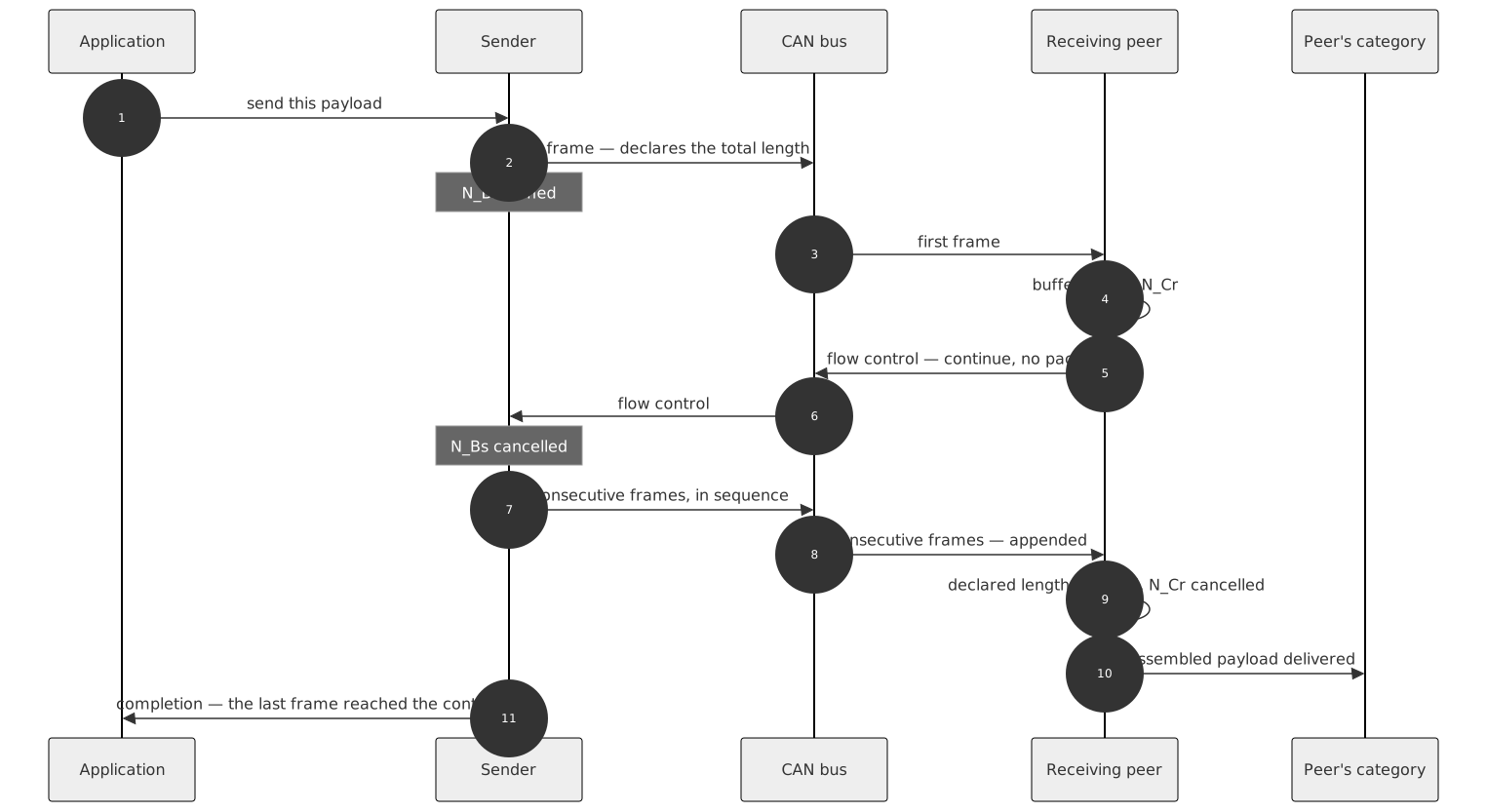
The two completions are independent, and neither is an end-to-end acknowledgement: the sender’s says the last frame reached its own controller, the receiver’s says the payload is complete. Confirming that the peer acted on it is the job of the category’s own protocol, one layer up.
5. Wiring segmentation into a category
Three steps, none of which touches the protocol core:
- Attach the transport to the server or the client, choosing the payload size and channel count — this is the sizing decision of Chapter 11.
- Register the receive channel for the identifier pair the category’s message will use.
- Give that message type a segmented handler, alongside its single-frame one.
Because a reassembled payload runs the same pipeline as a single frame, a validated category still finds its sequence number in the first byte and still skips it. The only difference a category sees is that the payload may be longer than eight bytes.
6. Deliberate omissions
Beyond the parameters in the specification, four things are simply not implemented, and each has a cost worth knowing before choosing this transport:
| Omission | Cost |
|---|---|
| Frames are never padded to full length | A peer that requires 8-byte frames will not interoperate; short frames keep a loaded bus shorter |
| The receiver never requests pacing | A receiver that needed it would have to become a configurable policy; nothing in the library does |
| Only normal addressing | No address extension, no mixed addressing |
| Classic CAN only | The length field and frame sizes assume 8-byte frames |
The first two are the pair worth revisiting first if can-lite ever has to talk to a third-party stack, because they are the ones a conventional diagnostic tester is most likely to insist on.