can-lite: Architecture & Design Decisions
Status: Living document Last updated: 2026-08-20
1. Overview
can-lite is a lightweight CAN bus protocol library implementing a client-server model over CAN 2.0B (29-bit extended identifiers). It is designed for bare-metal embedded systems with strict constraints: no heap allocation, bounded memory, and deterministic timing.

2. Design Principles
| Principle | Rationale |
|---|---|
| No heap allocation | Target MCUs have limited SRAM; all containers use
infra::BoundedVector, infra::BoundedDeque,
infra::Function, etc. from embedded-infra-lib. |
| Type-safe server/client separation | Prevents accidental registration of a client-side category handler on the server (and vice versa) at compile time. |
| Observer pattern over callbacks | Consistent notification mechanism using infra::Subject
/ infra::SingleObserver. Avoids storing
infra::Function objects for event dispatch; observers
auto-attach and auto-detach on construction/destruction. |
| Fixed-point encoding | Floating-point values are transmitted as scaled integers to avoid FPU dependencies and ensure deterministic wire representation. |
| Domain-neutral library | can-lite ships only protocol-level categories (System, Firmware Upgrade). Anything application-specific lives in the consuming project as an application category. |
| Extensible via categories | New functionality is added by implementing a category handler — no protocol core changes required. See Extending can-lite with categories. |
3. Category Type Hierarchy
A key architectural decision is the compile-time
separation of server-side and client-side categories. This
prevents a MyCategoryClient from being accidentally
registered on a CanProtocolServer.

CanCategory holds the shared logic: a
list of CanMessageType handlers, message dispatch via
HandleMessage(), and the pure virtual Id() and
RequiresSequenceValidation().
CanCategoryServer and
CanCategoryClient each carry their own
IntrusiveList node type, making them incompatible with each
other’s lists. CanProtocolServer holds an
IntrusiveList<CanCategoryServer> and
CanProtocolClient holds an
IntrusiveList<CanCategoryClient>, so type safety is
enforced at the compiler level.
Both base classes own the CanFrameTransport reference
and expose protected send helpers that fill in the category ID and
priority, so a concrete category never touches the frame layer directly.
Client categories additionally take a CanSequenceSource,
which supplies the per-server sequence byte — this keeps categories
independent of CanProtocolClient, so they link
can_lite.core only.
Default sequence validation: - Server categories
default to true — incoming commands carry a sequence byte
for replay protection. - Client categories default to
false — responses do not require sequence validation.
4. Message Type Dispatch
Each category contains a set of CanMessageType handlers,
registered via AddMessageType() /
AddMessageTypes() in the category constructor. In practice
these are CanMessageHandler<Owner> instances, which
bind a message type ID to a member function of the owning category — an
ID, a reference and a member pointer, with no allocation and no nested
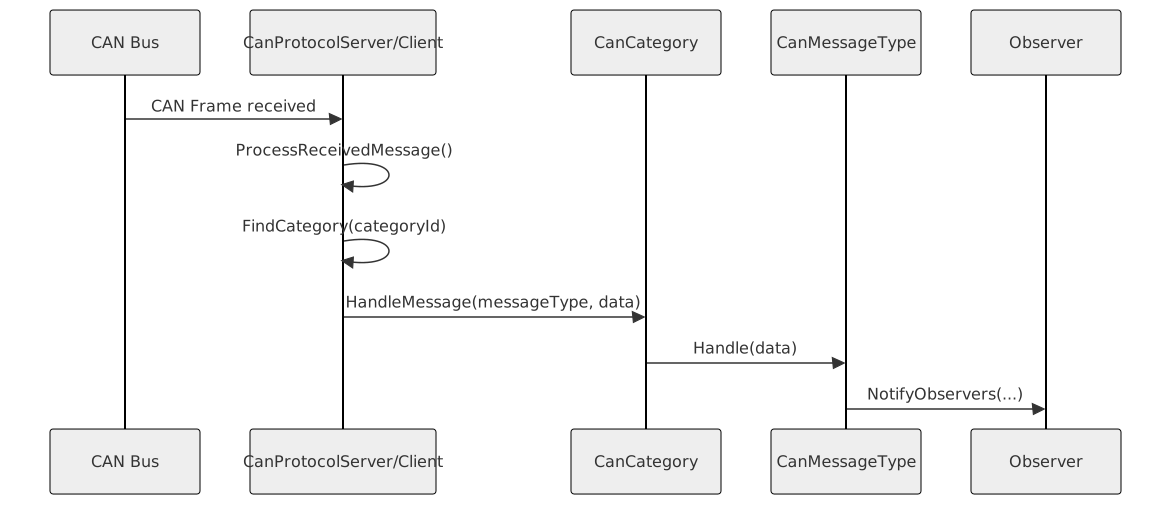
class per message. When a frame arrives:
CanProtocolServer/CanProtocolClientextracts the category ID and message type from the 29-bit CAN identifier.- The corresponding category’s
HandleMessage()is called. HandleMessage()iterates the registered message types and dispatches to the matching handler.- The handler parses the payload and notifies the observer.
5. Observer Pattern
All category handlers use infra::Subject<Observer>
/ infra::SingleObserver<Observer, Subject> for event
notification. This replaces earlier infra::Function
callbacks.
Key properties: - Single observer for
categories: Every category subject supports exactly one
observer (infra::SingleObserver). This matches the 1:1
relationship between a category instance and its consumer. -
Multiple observers at the protocol layer:
CanProtocolServerObserver and
CanProtocolClientObserver derive from
infra::Observer, so a
CanProtocolServer/CanProtocolClient accepts
more than one. The protocol subject legitimately has two interested
parties — the application and an optional
TracingCanProtocol*Observer (§13) — whereas a category has
one consumer. infra::Subject selects its single- or
multi-observer specialisation from the observer’s
SingleHelper typedef, so the two forms differ only in the
base class; NotifyObservers() and
Attach()/Detach() are identical. -
Auto-attach/detach: The observer attaches in its
constructor and detaches in its destructor — no manual registration
needed. - Zero-cost when unobserved:
NotifyObservers() checks for a null observer pointer
(single) or iterates an empty list (multiple) before dispatching, making
it safe to call with no observer attached.
Example — an application category (server side):
// Observer interface (pure virtual callbacks for each command)
class MyCategoryServerObserver
    : public infra::SingleObserver<MyCategoryServerObserver, MyCategoryServer>
{
public:
    virtual void OnSetParameters(int16_t first, const infra::Function<void()>& onDone) = 0;
};

// Subject (the category handler)
class MyCategoryServer
    : public CanCategoryServer
    , public infra::Subject<MyCategoryServerObserver>
{ ... };

// Application attaches by constructing an observer
class MyHandler : public MyCategoryServerObserver
{
public:
    explicit MyHandler(MyCategoryServer& server)
        : MyCategoryServerObserver(server) {}

    void OnSetParameters(int16_t first, const infra::Function<void()>& onDone) override { ... }
};
6. System Category Design
The System category (ID 0x00) is a
built-in category that handles protocol-level concerns:
heartbeat, status request, command acknowledgement, and category
discovery. It is split into server and client variants.
Server side:
CanSystemCategoryServer
The system category on the server is fully automatic
— no public API is exposed to the application developer.
CanProtocolServer creates an internal observer that reacts
to system messages:
| Message | Internal behavior |
|---|---|
| Heartbeat received | Notifies CanProtocolServerObserver::Online() |
| Status request | Sends heartbeat response |
| Category list request | Sends list of registered category IDs |
RegisterCategory() returns false, without
registering, if the category’s ID is already registered on that server
or if canMaxRegisteredCategories (8) categories are already
registered. The application interacts with
CanProtocolServer only through
RegisterCategory() and the
CanProtocolServerObserver (Online/Offline). All system
plumbing is hidden.
Client side:
CanSystemCategoryClient
The system category on the client exposes only category discovery through its observer:
| Exposed via observer | Description |
|---|---|
OnCategoryListResponse(categoryIds) |
Notifies when a category list is received from a server |
Command acknowledgement handling (§9.4) happens in
CanProtocolClient itself, not in
CanSystemCategoryClient, because it needs the source node
ID, which the category dispatch layer does not pass down to individual
message handlers. Category discovery is exposed because the application
may want to enumerate a server’s capabilities.
7. Bidirectional Category Pattern
Each application category is split into two classes that mirror the client-server protocol:

- Server category: Registers handlers for
commands (IDs
0x00–0x7F). Uses the inheritedSendResponse()/SendTelemetry()/SendCategoryError()helpers, which fill in the category ID and priority. - Client category: Registers handlers for
responses (IDs
0x80–0xFF). Uses the inheritedSendCommand(uint16_t targetNodeId, ...)helper, which directs each frame to a specific server and prepends the per-server sequence byte.
Server categories take a CanFrameTransport& in their
constructor. Client categories take a
CanFrameTransport& and a
CanSequenceSource&; CanProtocolClient
implements the latter, so categories depend only on
can_lite.core.
See Extending can-lite with categories for the full authoring guide.
8. CAN Identifier Layout
All 29 bits of the extended CAN ID encode routing information:
[28:24] Priority     (5 bits)  — message urgency
[23:20] Category     (4 bits)  — functional group (0x0 = System)
[19:12] Message Type (8 bits)  — specific command/response within category
[11:0]  Node ID      (12 bits) — target server address (0x000 = broadcast)
Priority values (lower = higher priority on the CAN bus):
| Priority | Value | Usage |
|---|---|---|
| Emergency | 0 | Reserved for safety-critical messages |
| Command | 4 | Client-to-server commands |
| Response | 8 | Server-to-client responses |
| Telemetry | 12 | Periodic data streams |
| Heartbeat | 16 | Presence detection |
9. Sequence Validation
Server-side categories validate an 8-bit sequence number in
data[0] of every command frame:
- The server tracks the last accepted sequence number.
- A command is accepted if its sequence number equals
(previous + 1) mod 256. - On sequence error, the server sends a
CommandAckwithsequenceErrorstatus. - The sequence counter wraps from 255 → 0.
Client-side categories skip sequence validation (responses are stateless).
The server keeps one counter, shared by all
sequence-validated categories. This is deliberate: the supported
topology is one client to many servers, and a server serves exactly one
client (REQ-CAN-006.1). Two clients commanding the same server
concurrently interleave their counters and are rejected with
sequenceError.
9.1 Per-Server Sequence Tracking
CanProtocolClient maintains independent sequence
counters per server node in a fixed-size array
(maxServers = 8) and exposes them through the
CanSequenceSource interface.
PeekSequence(nodeId) returns the next sequence byte for the
given node, and
CommitSequence(nodeId, category, messageType) advances it
once the frame has been accepted by the send queue — so a rejected frame
does not burn a sequence number. This ensures that commands directed to
different servers do not share or interfere with each other’s replay
protection state. CommitSequence also starts that server’s
command-ack timeout (§9.4), which is why it takes the category and
message type of the command just sent.
Sequence Resynchronization
A sequenceError acknowledgement carries the sequence
number the server expected (§9.4). CanProtocolClient parses
every acknowledgement frame as it arrives (before category dispatch,
since it still has the source node ID at that point) and, on
sequenceError, sets that server’s counter to the reported
value. This recovers a client whose sequence state has drifted from the
server’s — for example after the client process restarts and its
in-memory counter resets to 0 while the server, unaware of the restart,
still expects its old counter to continue — without requiring the server
to also reset.
9.2 Server Liveness Detection
CanProtocolClient detects server online/offline
transitions:
- Every received frame with a non-broadcast source node ID is passed
to
MarkServerAlive(nodeId). - On first reception from a node,
CanProtocolClientObserver::OnServerOnline(nodeId)is called. - A
TimerSingleShot(configurable, default 3 s) is (re)started on each frame. If no frame is received before the timer fires,CanProtocolClientObserver::OnServerOffline(nodeId)is called. - Up to 8 server liveness slots are tracked simultaneously.
Applications connect a CanProtocolClientObserver to
receive these events and react accordingly (e.g., stop issuing commands,
alert the UI).
9.2.1 Client Liveness Detection (Server-side)
CanProtocolServer detects the reverse direction: whether
its client is still present. CanProtocolClient broadcasts
its own heartbeat (node ID 0x000) following the same
quiet-period rule as the server’s heartbeat (§9.3); since that heartbeat
is deferred by any other outgoing traffic, a client sending commands
continuously might not emit a dedicated heartbeat frame for a long time.
CanProtocolServer therefore restarts its
clientLivenessTimer (configurable, default 3 s via
Config::clientTimeout) on any frame correctly addressed to
it, not only heartbeats — mirroring how
CanProtocolClient::MarkServerAlive treats any received
frame as proof of a server’s liveness (§9.2). Only a received heartbeat
notifies CanProtocolServerObserver::Online(), since that is
the specific, meaningful signal; if the timer fires without further
traffic from the client,
CanProtocolServerObserver::Offline() is notified. A server
tracks liveness for one client only, consistent with the single sequence
counter (§9).
9.3 Heartbeat Timer (Silence Guard)
Both CanProtocolServer and
CanProtocolClient use a TimerSingleShot
instead of a TimerRepeating for heartbeat emission. The
timer is restarted (ResetHeartbeatTimer()) after every
outgoing frame on that side. This means a heartbeat is only sent when
that side has been silent for the full heartbeat
interval, preventing unnecessary heartbeat traffic on active buses. The
client’s heartbeat is a broadcast, since a client has no node ID of its
own on the bus.
9.4 Command Acknowledgement Timeout
When CanCategoryClient::SendCommand sends a
sequence-validated command,
CanProtocolClient::CommitSequence starts a per-server
ackTimer (configurable, default 1 s via
Config::commandAckTimeout) alongside the category and
message type of the command sent. Any acknowledgement frame from that
server matching that (category, messageType) cancels the timer,
regardless of its status. If the timer fires first,
CanProtocolClientObserver::OnCommandAckTimeout(nodeId, category, messageType)
is notified; the command is not automatically retried. Because a server
can have at most one outstanding command tracked this way, sending a
second sequence-validated command to the same server before the first is
acknowledged replaces the tracked (category, messageType) — an
acknowledgement for the first command that arrives afterward will not
match and will not cancel the timer for the second.
10. Directory Structure
can-lite/
├── core/                          # Protocol primitives
│   ├── CanCategory.hpp/cpp        # Base class + Server/Client subclasses
│   ├── CanMessageType.hpp         # Message handler interface
│   ├── CanMessageHandler.hpp      # Binds a message type ID to a member function
│   ├── CanPayload.hpp/cpp         # Bounds-checked big-endian payload reader/writer
│   ├── CanSequenceSource.hpp      # Per-server sequence supply for client categories
│   ├── CanProtocolDefinitions.hpp # CAN ID layout, constants, enums
│   ├── CanFrameCodec.hpp/cpp      # Fixed-point encoding helpers
│   ├── CanFrameTransport.hpp/cpp  # Async send queue over hal::Can
│   └── test/                      # Unit tests + can_lite.test_util doubles
├── categories/
│   ├── system/                    # Built-in System category (0x00)
│   │   ├── CanSystemCategoryServer.hpp/cpp
│   │   └── CanSystemCategoryClient.hpp/cpp
│   └── firmware_upgrade/          # Firmware Upgrade category (0x01)
│       ├── FirmwareUpgradeDefinitions.hpp
│       ├── FirmwareUpgradeCategoryServer.hpp/cpp
│       ├── FirmwareUpgradeCategoryClient.hpp/cpp
│       └── test/
├── transport/                     # ISO-TP segmentation layer
│   ├── IsoTpTransport.hpp         # Abstract interface
│   ├── IsoTpTransportImpl.hpp/cpp # Non-template concrete impl (WithStorage)
│   └── iso-tp/                    # ISO 15765-2 internals
│       ├── IsoTpChannel.hpp       # Non-template abstract channel interface
│       ├── IsoTpChannelImpl.hpp/cpp # Non-template concrete channel (WithStorage<MaxPduSize>)
│       ├── IsoTpSender.hpp/cpp    # Non-template transmit FSM (WithStorage<MaxPduSize>)
│       ├── IsoTpReceiver.hpp/cpp  # Non-template receive FSM (WithStorage<MaxPduSize>)
│       ├── IsoTpFrameCodec.hpp/cpp # PCI encoding/decoding
│       └── IsoTpTypes.hpp         # Enums, constants (FrameType, FlowStatus, AbortReason)
├── server/                        # CanProtocolServer
│   ├── CanProtocolServer.hpp/cpp
│   └── test/
├── client/                        # CanProtocolClient
│   ├── CanProtocolClient.hpp/cpp
│   └── test/
├── tracing/                       # Optional tracing decorators (§13)
│   ├── TracingCan.hpp/cpp                        # hal::Can decorator
│   ├── TracingIsoTpTransport.hpp/cpp             # IsoTpTransport decorator
│   ├── TracingCanProtocolServerObserver.hpp/cpp  # protocol-layer events
│   ├── TracingCanProtocolClientObserver.hpp/cpp
│   └── test/
└── drivers/                       # Hardware driver adapters

examples/                          # Not built by default (CAN_LITE_BUILD_EXAMPLES)
└── foc_motor/                     # Reference application category
Application categories live in the consuming project, not in
can-lite/categories/.
10.1 ISO-TP Transport Layer
The transport layer provides multi-frame PDU segmentation and
reassembly following ISO 15765-2 without coupling it to any specific
application category. It is an optional, orthogonal mechanism:
categories that need large payloads attach
IsoTpTransportImpl to the server/client; categories that
fit in 8 bytes continue using raw CanFrameTransport
directly.
Key classes:
| Class | Role |
|---|---|
IsoTpTransport |
Abstract interface — RegisterReceiveChannel,
SendPdu, ProcessFrame,
SetOnPduReceived |
IsoTpTransportImpl |
Non-template concrete implementation; channel pool via
WithStorage<MaxPduSize, MaxChannels> |
IsoTpChannel |
Non-template abstract channel interface used by
IsoTpTransportImpl |
IsoTpChannelImpl |
Non-template concrete channel; composes IsoTpSender +
IsoTpReceiver via
WithStorage<MaxPduSize> |
IsoTpSender |
Non-template transmit FSM (SF → FF → wait-for-FC → CFs; N_Bs
timeout); WithStorage<MaxPduSize> provides
buffer |
IsoTpReceiver |
Non-template receive FSM (SF dispatch or FF → wait-for-CFs; N_Cr
timeout); WithStorage<MaxPduSize> provides
buffer |
IsoTpFrameCodec |
Stateless PCI encode/decode helpers |
WithStorage pattern — zero-heap construction chain:
All ISO-TP classes are non-template at their API surface. Sizes are
injected via nested WithStorage type aliases that use
EMIL’s infra::WithStorage to compose storage ownership:
// IsoTpSender takes BoundedVector<uint8_t>& — WithStorage provides the buffer
IsoTpSender::WithStorage<MaxPduSize>  // IS-A IsoTpSender

// IsoTpReceiver — same pattern
IsoTpReceiver::WithStorage<MaxPduSize>  // IS-A IsoTpReceiver

// IsoTpChannelImpl composes sender + receiver storage in a nested struct
IsoTpChannelImpl::WithStorage<MaxPduSize>  // IS-A IsoTpChannelImpl IS-A IsoTpChannel

// IsoTpTransportImpl composes a BoundedVector of channels
IsoTpTransportImpl::WithStorage<MaxPduSize, MaxChannels>  // IS-A IsoTpTransportImpl
Attachment pattern:
IsoTpTransportImpl::WithStorage<64, 4> isoTp{ canFrameTransport };
protocolServer.AttachIsoTpTransport(isoTp);
CanProtocolServer::ProcessReceivedMessage offers each
incoming frame to the ISO-TP layer first
(isoTpTransport->ProcessFrame(canId, frame)). If the
transport claims it (a registered channel matches), normal category
dispatch is skipped. This keeps the transport layer transparent to
existing category handlers.
11. Build System
- CMake presets are the primary interface (see
CMakePresets.json). - Libraries follow the
can_lite.<component>naming convention. - Category libraries link
can_lite.core; protocol libraries link the relevant category libraries. - Unit tests use GoogleTest/GMock and run on the host.
- Standalone builds fetch
embedded-infra-libvia FetchContent.
12. Integration Testing
Integration tests validate end-to-end behavior across components
using cucumber-cpp-runner
v4.0.0 (BDD / Gherkin). Feature files are in
integration_tests/features/; step definitions in
integration_tests/steps/.
Single Common Fixture
All scenarios share a single fixture type —
ApplicationFixture — that simulates a real application with
a server, client, and virtual CAN bus. This ensures tests exercise the
same initialization and interaction paths as production code.
integration_tests/
├── features/                      # Gherkin .feature files
├── hooks/                         # Scenario lifecycle hooks
├── steps/                         # Step definitions (GIVEN/WHEN/THEN)
└── support/
    └── ApplicationFixture.hpp      # VirtualCan, ApplicationFixture, mocks
VirtualCan
VirtualCan is a concrete hal::Can
implementation that replaces hardware drivers in integration tests. Two
VirtualCan instances are connected via
ConnectTo(): frames sent by one are delivered to the
other’s receive callback, simulating a shared CAN bus without mocking
SendData/ReceiveData.
InjectFrame() allows direct frame injection for testing
error paths.
ApplicationFixture
ApplicationFixture inherits from
infra::ClockFixture (providing
EventDispatcher, TimerService, and
ForwardTime()) and composes:
- A pair of connected
VirtualCaninstances (server-side and client-side). CanProtocolServerandCanProtocolClientwired to their respective CAN interfaces.StrictMockobservers for the server and (optionally) the demo category.- Optional demo category components (
CanFrameTransport,DemoCategoryServer/Client, observers) activated viaRegisterDemoCategory(). The demo category (0x3) is the reference application category used to validate the extension API end to end. - Optional Firmware Upgrade components
(
FirmwareUpgradeCategoryServer/Client, observers) activated viaRegisterFirmwareUpgrade(). - Dynamic test categories (
SequencedTestCategory,SimpleTestCategory) for sequence and discovery testing.
StrictMock Everywhere
All mock observers use testing::StrictMock. Unexpected
calls cause immediate test failure, ensuring every interaction is
explicitly expected.
Cucumber Context API
context.Emplace<T>(args...)creates the fixture (returnsstd::shared_ptr<T>).context.Get<T>()retrieves it by reference (returnsT&).- Captured
shared_ptrin lambdas on fixture members must be avoided to prevent circular references that leak the fixture across scenarios.
13. Observability
Tracing is provided by decorators the consumer opts into in
the composition root. Nothing in the library holds a
services::Tracer&; a build that never constructs a
decorator pays nothing. Threading a tracer through
CanFrameTransport, the protocol classes and every category
was rejected: it would change every constructor signature and add a
dependency to code that currently links can_lite.core only.
.github/linters/goodcheck.yml enforces the same conclusion
by forbidding services::GlobalTracer() in production
code.
Layers and seams
| Layer | Seam | Class |
|---|---|---|
| HAL | hal::Can |
TracingCan |
| Transport | IsoTpTransport |
TracingIsoTpTransport |
| Protocol | CanProtocolServerObserver /
CanProtocolClientObserver |
TracingCanProtocolServerObserver /
TracingCanProtocolClientObserver |
TracingCan sees all traffic in both
directions, including frames dropped later by node-ID filtering, rate
limiting, or unregistered categories. The protocol observers cover what
the frame log structurally cannot show: OnCommandAckTimeout
and both Offline transitions are timer-driven and put
nothing on the bus, so without them a quiet bus and a bus whose
acknowledgements are being missed look identical.
The category layer has no decorator.
CanCategory::HandleMessage and
HandlePduMessage are non-virtual, so decorating a category
would mean making dispatch virtual in core — for information already
derivable from the frame trace and the decoded commandAck
line.
Wiring
services::TracingCan tracingCan{ realCan, tracer };
services::CanProtocolServer server{ tracingCan, config };

services::TracingIsoTpTransport tracingIsoTp{ isoTp, tracer };
server.AttachIsoTpTransport(tracingIsoTp);

services::TracingCanProtocolServerObserver serverTrace{ server, tracer };
Line format
Every line is <ClassName>: <message>, so a
mixed log stays attributable to a layer and filters with a single
grep Tracing:
TracingCan: TX id 0x4001123 prio command cat 0x0 system type 0x1 heartbeat node 0x123 dlc 3 data 010203
TracingCan: ack cat 0x3 type 0x5 status sequenceError expectedSeq 0x7
TracingIsoTpTransport: Abort dataId 0x18db33f1 reason nCrTimeout
TracingCanProtocolClientObserver: CommandAckTimeout node 0x123 cat 0x3 type 0x5
Targets
One target per layer, so a consumer links only what it instruments:
can_lite.tracing (core),
can_lite.tracing_iso_tp (transport),
can_lite.tracing_protocol (server + client). All three
additionally link services.tracer.
services::Tracer::Trace() returns
infra::TextOutputStream under
EMIL_ENABLE_TRACING and a no-op type under
EMIL_DISABLE_TRACING, so every trace line is written as a
single chained expression — the result is never stored, and
Continue() is never used to append a conditional part.