can-lite: Protocol Specification
Version: 1.0
Protocol Version Byte: 1
Status: Draft
Date: 2026
1. Abstract
This document specifies the can-lite CAN bus protocol, a lightweight client-server communication protocol operating over CAN 2.0B (29-bit extended identifiers) at up to 1 Mbit/s. The protocol provides a minimal built-in System category with heartbeat, command acknowledgement, status request, and category discovery messages. Applications extend the protocol by registering custom category handlers on the server.
2. Terminology
| Term | Definition |
|---|---|
| Server | A node on the CAN bus that listens for commands, processes them, and sends responses. Each server has a unique node ID and serves exactly one client. |
| Client | The initiator of all commands and queries. A single client can communicate with multiple servers. |
| Broadcast | A message addressed to all servers (node ID 0x000) |
| Category | A 4-bit field in the CAN identifier that groups related message types. The built-in System category (0x0) is always available; applications register additional categories. |
| Category Handler | A CanCategoryServer or CanCategoryClient
implementation registered via RegisterCategory() that
processes all messages for a specific category. |
| Sequence Number | An 8-bit counter in byte[0] of command frames for replay protection |
| Scale Factor | Integer multiplier used to convert floats to fixed-point integers |
3. Architecture
The protocol follows a client-server model:
- The client is the sole initiator of commands and queries. It can address multiple servers on the same CAN bus by targeting different node addresses. The client maintains independent sequence counters per server.
- The server passively listens for incoming frames addressed to its node ID (or the broadcast address). It processes commands, dispatches them to the appropriate category handler, and sends acknowledgement responses.
- The topology is one client to many servers. A server serves exactly one client and keeps a single sequence counter; addressing one server from two clients concurrently is not supported and is rejected with a sequence error.
- Both the server and the client automatically transmit heartbeat
messages starting from construction. Each side uses the presence or
absence of the other’s heartbeats to determine whether its peer is
online or offline: the client notifies
the application via
CanProtocolClientObserver(OnServerOnline(nodeId)/OnServerOffline(nodeId)), and the server viaCanProtocolServerObserver(Online()/Offline()).

4. Transport
- Physical layer: CAN 2.0B
- Bit rate: up to 1 Mbit/s (configurable)
- Identifier format: 29-bit extended only; 11-bit frames are silently discarded
- Maximum payload: 8 bytes per frame (CAN 2.0 standard)
4.1 ISO-TP Segmentation (ISO 15765-2)
For payloads exceeding the 8-byte CAN frame limit, can-lite provides
an optional ISO-TP transport layer (IsoTpTransportImpl)
that implements ISO 15765-2 segmentation and reassembly.
Frame Types
| PCI Nibble | Frame Type | Description |
|---|---|---|
0x0N |
Single Frame (SF) | N = data length (1–7); entire PDU fits in one frame |
0x1NNN |
First Frame (FF) | NNN = total PDU length (8–4095); first 6 bytes |
0x2N |
Consecutive Frame | N = sequence number 0–F (wraps); up to 7 bytes |
0x3S |
Flow Control (FC) | S = status: 0=CTS, 1=Wait, 2=Overflow |
Flow Control Fields
| Byte | Field | Description |
|---|---|---|
| 0 | PCI | 0x3S — Flow Status (0=CTS, 1=Wait, 2=Overflow) |
| 1 | BS | Block Size — number of CFs before next FC (0 = unlimited) |
| 2 | STmin | Minimum separation time: 0x00–0x7F = 0–127 ms; 0xF1–0xF9 = 100–900 µs (ISO-TP sub-ms range); 0x80–0xF0 and 0xFA–0xFF = reserved (treated as 0x7F / 127 ms per ISO 15765-2) |
Timing Parameters
| Parameter | Value | Description |
|---|---|---|
| N_Bs | 1000 ms | Sender timeout waiting for a Flow Control frame |
| N_Cr | 1000 ms | Receiver timeout waiting for a Consecutive Frame |
| N_WFTmax | 16 | Maximum consecutive Flow Control Wait frames before the
sender aborts (implementation-defined per ISO 15765-2) |
On FS = Wait, the sender restarts N_Bs and continues
waiting rather than aborting immediately; only N_WFTmax
consecutive Wait frames (or an N_Bs timeout) abort the
transfer.
Integration
IsoTpTransportImpl is attached to
CanProtocolServer or CanProtocolClient via
AttachIsoTpTransport(IsoTpTransport&). When attached,
incoming frames are first offered to the ISO-TP layer; if no registered
channel claims the frame, it falls through to normal category dispatch.
PDUs reassembled by the transport layer are delivered via the
SetOnPduReceived callback. Channels are reclaimed via
ReleaseChannel(dataId), called automatically on abort and
available for the application to call once it is done with a given
dataId.
The implementation uses WithStorage for zero-heap
construction. All internal components (IsoTpSender,
IsoTpReceiver, IsoTpChannelImpl) are
non-template classes that receive their PDU buffer storage via
infra::WithStorage aliases, following the EMIL
convention:
IsoTpTransportImpl::WithStorage<64, 4> isoTp{ canFrameTransport };
protocolServer.AttachIsoTpTransport(isoTp);

isoTp.RegisterReceiveChannel(dataId, fcId);
Addressing constraint.
IsoTpTransportImpl routes frames to channels purely by the
literal CAN ID carried in dataId/fcId — the
sender’s identity is not otherwise encoded.
AttachIsoTpTransport() alone does not register any channel;
the application (or a category built on top of it) must explicitly call
RegisterReceiveChannel() for each
dataId/fcId pair it expects multi-frame
traffic on, using IDs that unambiguously identify a single correspondent
(e.g. a dedicated node-to-node exchange such as a firmware upload
session). A dataId shared by more than one concurrent
sender at a time will have their frames interleaved into the same
channel; the transport layer does not detect or reject this. Because of
this, can-lite does not provide automatic multi-frame support for
arbitrary category command/response traffic across many nodes — only the
point-to-point case with an explicitly-managed channel is supported.
5. CAN Identifier Layout
All 29 bits of the extended CAN ID are structured as follows:
Bit:  28  27  26  25  24  23  22  21  20  19  18  17  16  15  14  13  12  11  10  9   8   7   6   5   4   3   2   1   0
     |----  Priority  ----|-- Category --|------  Message Type  ------|----------------- Node ID -------------------|
     |     5 bits (0-31)  |  4 bits (0-F)|       8 bits (0-FF)       |             12 bits (0-FFF)                  |
Field Encoding:
raw_id = (priority << 24) | (category << 20) | (message_type << 12) | node_id6. Priority Levels
| Value | Name | Usage |
|---|---|---|
| 0 | Emergency | Safety-critical events |
| 4 | Command | Commands, parameter writes |
| 8 | Response | Command acknowledgements |
| 12 | Telemetry | Periodic measurements |
| 16 | Heartbeat | Node liveness |
Lower numerical values have higher CAN bus arbitration priority.
7. Message Categories
| Value | Name | Description |
|---|---|---|
| 0x0 | System | Heartbeat, command acknowledgement, status request, category discovery |
| 0x1 | Firmware Upgrade | Block-based firmware transfer, verification, and activation |
| 0x2 - 0xF | Application | Reserved for application-defined categories |
The System category is always available. Category 0x1 is defined in a separate extension specification:
Applications register additional categories (values 0x2-0xF) by
providing CanCategoryServer and
CanCategoryClient implementations to
CanProtocolServer::RegisterCategory() and
CanProtocolClient::RegisterCategory(). Both return
false, without registering, if the category’s ID is already
registered or if 8 categories are already registered (the System
category always occupies one of those 8 slots). See Extending can-lite with
categories.
7.1 Reserved Message Type
Message type 0xFE is reserved across all categories for
a category error response, carrying a category-specific
failure detail that the universal acknowledgement status cannot
express.
| Byte | Field | Type | Description |
|---|---|---|---|
| 0 | Originating Command | uint8 | Message type of the command that failed |
| 1 | Error Code | uint8 | Category-defined error code |
A category error response is normally followed by a command
acknowledgement with status categoryError.
8. Message Catalog
8.1 System (Category 0x0)
8.1.1 Heartbeat (Type 0x01)
Sent at CanPriority::heartbeat. No sequence validation.
| Byte | Field | Type | Description |
|---|---|---|---|
| 0 | Version | uint8 | Protocol version (currently 1) |
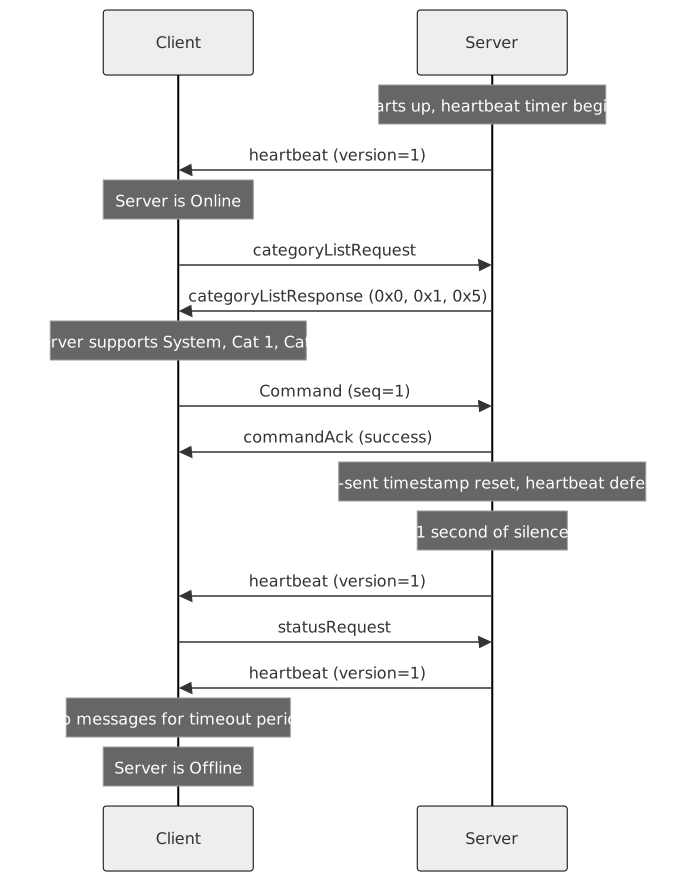
Both the server and the client automatically transmit heartbeat messages starting from the moment they are constructed. A heartbeat is sent at least 1 second after the last transmitted message of any kind, by whichever side is sending it. This ensures liveness detection without adding traffic when that side is already actively communicating. The heartbeat acts as a keep-alive: it fires only during periods of silence. The client’s heartbeat is broadcast (node ID 0x000), since the client has no node ID of its own on the bus.
The client uses received heartbeats to track server liveness. When a
heartbeat (or any message) is received from a server, the client
considers that server online and resets that server’s
timeout timer. If no messages are received from a server within a
configurable timeout (default 3 s), the client considers it
offline and notifies the application via
CanProtocolClientObserver::OnServerOffline(nodeId).
Multiple servers (up to 8) can be tracked simultaneously with
independent liveness timers.
Symmetrically, the server uses received traffic to track whether its
client is still present. Any frame correctly addressed to the server
(re)starts the server’s client timeout timer (default 3 s,
Config::clientTimeout), the same “any message counts” rule
the client uses for server liveness; a heartbeat specifically also
notifies the application via
CanProtocolServerObserver::Online(). If the timeout timer
expires without further traffic from the client, the server notifies
CanProtocolServerObserver::Offline(). A server tracks only
one client, per REQ-CAN-006.1.
8.1.2 Command Acknowledgement (Type 0x02)
Sent by the server at CanPriority::response.
| Byte | Field | Type | Description |
|---|---|---|---|
| 0 | Category | uint8 | CanCategory of the acknowledged command |
| 1 | Command | uint8 | CanMessageType of the acknowledged command |
| 2 | Status | uint8 | See acknowledgement status table |
| 3 | Expected Sequence | uint8 | Meaningful only when Status is Sequence Error (4); 0 otherwise |
The category byte ensures the client can uniquely identify which command is being acknowledged, since message type values may be reused across categories.
On receiving a sequenceError acknowledgement, the client
adopts byte 3 as its next sequence number for that server, so that a
single lost frame, or the client’s own sequence state having reset (for
example after a restart), does not leave the two sides permanently out
of sync — see §11.
If no acknowledgement of any status arrives for a sequence-validated
command within a configurable timeout (default 1 s,
Config::commandAckTimeout), the client notifies the
application via
CanProtocolClientObserver::OnCommandAckTimeout(nodeId, category, messageType).
The command itself is not retried; the application decides whether and
how to retry.
8.1.3 Status Request (Type 0x03)
Sent by the client at CanPriority::command. No sequence validation. Empty payload.
When received, the server responds by transmitting a heartbeat message. This allows the client to quickly confirm the server is online without waiting for the next scheduled heartbeat.
8.1.4 Category List Request (Type 0x04)
Sent by the client at CanPriority::command. No sequence validation. Empty payload.
When received, the server responds with a Category List Response message containing the IDs of all registered category handlers.
8.1.5 Category List Response (Type 0x05)
Sent by the server at CanPriority::response.
| Byte | Field | Type | Description |
|---|---|---|---|
| 0 | Category 0 | uint8 | First registered category ID |
| 1 | Category 1 | uint8 | Second registered category ID |
| … | … | uint8 | Additional category IDs (up to 8 max) |
Each byte contains the ID of one registered category handler. The
System category (0x0) is always included. Categories are listed in
registration order. The response is limited to 8 category IDs by the CAN
frame payload size. RegisterCategory() enforces this bound
at registration time: the 9th and any subsequent registration attempt
returns false and the category is not registered, so the
response can never truncate.
9. Data Encoding
All multi-byte integers are encoded big-endian (network byte order).
9.1 Encoding Algorithm
fixed_value = clamp(round(float_value × scale_factor), INT_MIN, INT_MAX)
float_value = fixed_value / scale_factor
Values are saturated (clamped) to the target integer range to prevent overflow.
10. Enumeration Tables
10.1 Acknowledgement Status
| Value | Status | Description |
|---|---|---|
| 0 | Success | Command accepted and processed |
| 1 | Unknown Command | Message type not recognized for category |
| 2 | Invalid Payload | Payload too short or field out of range |
| 3 | Invalid State | Command not valid in current state |
| 4 | Sequence Error | Sequence number not (previous + 1) mod 256 |
| 5 | Rate Limited | Message rate limit exceeded |
| 6 | Not Implemented | Command recognized but handler not implemented |
| 7 | Category Error | Category-specific rejection; details in category 0xFE frame |
11. Sequence Number Protocol
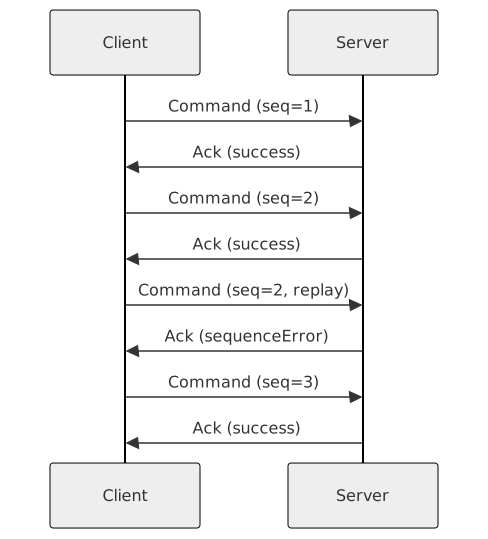
- For command frames that carry a payload, Byte[0] is an unsigned 8-bit sequence counter used for best-effort in-order processing.
- The server accepts the first sequenced command received regardless of sequence value and records it as the reference.
- Each subsequent command should have sequence = (previous + 1) mod 256.
- Out-of-order or duplicated commands are rejected with a
sequenceErroracknowledgement. - Individual category handlers declare whether they require sequence
validation via
RequiresSequenceValidation(). Categories that opt out bypass validation entirely. - When sequence validation is required and the payload is empty (no
sequence byte present), the frame is rejected with
invalidPayload. - Heartbeat and status request frames do not use sequence numbers.
- Unrecognized message types within a registered category are rejected
with an
unknownCommandacknowledgement. - A
sequenceErroracknowledgement carries the sequence number the server expected (§8.1.2); the client adopts it as its next sequence number for that server. This recovers a client whose own sequence state has drifted from the server’s (for example, after the client process restarts and its in-memory counter resets to 0 while the server, unaware of the restart, still expects its old counter to continue) without requiring the server to also restart. - Sequence numbers are not an authentication or security mechanism and MUST NOT be relied upon to prevent malicious replay on an untrusted CAN bus.
12. Rate Limiting
The server enforces a configurable maximum message rate (default: 500 messages per period). Messages received after the limit is reached are silently discarded. The rate counter resets automatically every second via an internal timer.

13. Node Addressing
- Each server has a unique 12-bit node ID (1–4095) set at configuration time.
- Node ID 0x000 is reserved as the broadcast address.
- Frames addressed to the broadcast ID are accepted by all servers.
- Frames addressed to a different node ID are silently discarded.
14. Typical Command Flow
15. Extensibility
Applications extend can-lite by defining additional categories:
- Define an enum value for the new category (0x2–0xF; 0x1 is reserved for Firmware Upgrade).
- Implement
CanCategoryServerandCanCategoryClientsubclasses that handle the message types within that category. - Register the handler with the server at construction time.
The server dispatches incoming frames to the matching category
handler. Frames with unregistered categories are silently discarded.
Frames with a registered category but an unknown message type receive an
unknownCommand acknowledgement.
16. Security Considerations
- In-order delivery / duplicate detection: Sequence number validation rejects out-of-order or duplicated commands. This is a best-effort ordering check, not a security mechanism — see §11’s caveat: sequence numbers are transmitted in the clear and MUST NOT be relied upon to prevent malicious replay on an untrusted CAN bus.
- Bus flooding protection: Configurable rate limiting discards excess messages.
- Input validation: All payloads are length-checked
before parsing. Enum-valued fields are decoded via unchecked
static_castfrom the wire byte; an out-of-range value produces a scoped-enum value with no matching enumerator (well-defined per the C++ standard, since these enums have a fixed underlying type) rather than a rejected frame — it is not currently validated against the enum’s defined range. - No heap allocation: Fixed-size buffers prevent memory exhaustion.
- Node isolation: Strict node ID filtering prevents cross-node interference.